
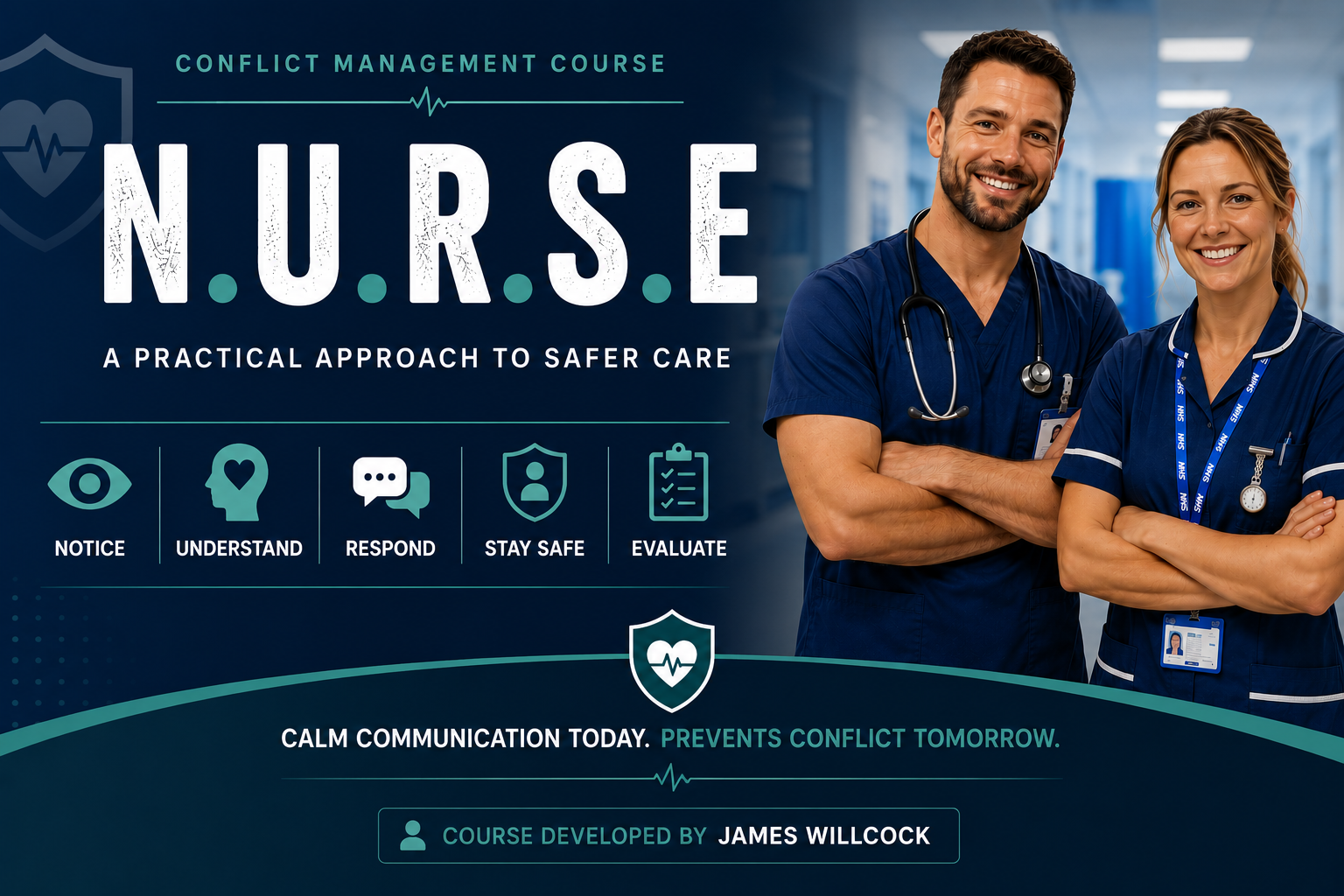
How the N.U.R.S.E framework, Notice, Understand, Respond, Stay Safe, Evaluate, helps healthcare staff manage conflict and supports NHS organisations in meeting the Violence Prevention and Reduction Standard, Version 2, 2024.
Working in healthcare has always required much more than clinical knowledge. Doctors, nurses, healthcare assistants, reception teams, porters, paramedics, community staff, mental health workers and other NHS professionals regularly find themselves dealing with people who are frightened, confused, frustrated, distressed, intoxicated, experiencing mental ill health or in significant pain.
Most interactions are completely routine. Some become challenging. A small number escalate into aggression, threats or physical violence.
When that happens, NHS staff need more than a policy telling them what they should do. They need practical skills. They need to understand how conflict develops, how their own behaviour can influence an interaction, how to recognise the early warning signs of escalation, how to communicate effectively under pressure and, importantly, how to safely disengage if somebody attempts to grab, restrain or assault them.
That is the thinking behind the N.U.R.S.E Conflict Management and Breakaway Training Course. Developed around the realities faced by people working in healthcare and other public-facing environments, N.U.R.S.E combines communication, situational awareness, dynamic risk assessment, de-escalation, personal safety and practical breakaway skills within one structured approach.
Crucially, the programme has also been designed to align with and support NHS organisations in meeting the principles and expectations of the NHS England Violence Prevention and Reduction Standard, Version 2, 2024.
The aim is not to turn healthcare workers into security officers. It is to give them the confidence, knowledge and practical tools to recognise risk earlier, manage conflict more effectively and protect themselves when communication alone is no longer enough.
Violence and Aggression Remain a Significant NHS Issue
Violence towards NHS staff cannot simply be dismissed as "part of the job".
NHS England's latest published violence prevention information reports that 14.47% of NHS staff responding to the 2025 NHS Staff Survey experienced at least one incident of physical violence from patients, service users, relatives or members of the public during the previous 12 months. More than a quarter, 25.25%, reported experiencing harassment, bullying or abuse from patients, service users, relatives or members of the public.
Behind those percentages are real people. A nurse working a night shift. A receptionist dealing with an increasingly aggressive relative. A healthcare assistant supporting a confused patient. A community worker entering somebody's home alone. A clinician delivering difficult news. A porter attempting to move a patient who has become distressed or frightened.
The risk is not the same for everybody, which is why effective violence prevention cannot simply consist of giving every employee exactly the same training. That principle sits at the heart of both N.U.R.S.E and the NHS Violence Prevention and Reduction approach.
What Is the NHS Violence Prevention and Reduction Standard?
The NHS England Violence Prevention and Reduction Standard, Version 2, was published in December 2024. It provides NHS organisations with a systematic framework for preventing and reducing violence and abuse against staff.
The updated Standard contains 43 indicators across seven domains:
- Leadership and accountability
- Governance and assurance
- Collaboration
- Data
- Workforce
- Interventions
- Evaluation
The intention is not simply to react to violence after it has occurred. The Standard promotes a proactive, preventative and increasingly public health and trauma-informed approach to understanding why violence occurs and what organisations can do to reduce the likelihood and consequences of it happening.
That is an important distinction.
Violence prevention should not start when somebody throws a punch. It starts much earlier. It starts with identifying risk. Understanding behaviour. Recognising patterns. Training staff. Designing environments appropriately. Reporting incidents. Learning from them. Supporting staff afterwards. And continually improving the organisation's response.
Where Does N.U.R.S.E Fit Within the NHS VPR Standard?
It is important to be accurate about what "compliance" means. No single training course can make an NHS Trust or healthcare provider fully compliant with the VPR Standard. The Standard covers organisation-wide governance, leadership, data, risk assessment, workforce arrangements, interventions and evaluation. Training is one part of that wider system.
N.U.R.S.E has therefore been designed to support organisational compliance with the NHS VPR Standard by providing a risk-based conflict management and breakaway training intervention that can be incorporated into an organisation's wider Violence Prevention and Reduction strategy.
This is particularly relevant to the Standard's Workforce, Interventions and Evaluation domains, while also supporting wider risk management, reporting and organisational learning.
NHS guidance has specifically highlighted the importance of being able to demonstrate that a Violence Prevention and Reduction Training Needs Analysis has been undertaken, informed by relevant risk assessments, and that suitable and relevant training, development and support have then been made available to staff. The guidance also asks organisations to consider how training interventions are evaluated and demonstrated to be fit for purpose.
That is exactly how N.U.R.S.E should be implemented.
Training Should Follow Risk
A fundamental principle of the N.U.R.S.E programme is:
Training should follow risk, not job title alone.
A receptionist in an emergency department does not necessarily require the same level of training as somebody working in an administrative office away from patient-facing activity. A lone community healthcare worker may require different personal safety skills from somebody permanently working as part of a multidisciplinary ward team. Mental health staff may encounter different behavioural risks from those working in an outpatient clinic. Emergency Department staff may face another risk profile entirely.
For this reason, N.U.R.S.E can be integrated with a role-based Training Needs Analysis. Organisations can consider:
- Which staff are exposed to violence and aggression?
- What types of incidents are occurring?
- Where are they occurring?
- When are incidents occurring?
- What behaviours are staff encountering?
- Are particular roles disproportionately exposed?
- Are people lone working?
- Are staff expected to enter uncontrolled environments?
- What existing control measures are available?
- What does incident-reporting data tell us?
- What skills do staff currently have?
- Where are the gaps?
The resulting training can then be proportionate to the actual risk. This supports the wider VPR principle of using evidence, risk assessment and local data to identify interventions rather than simply applying a generic training package across an entire workforce.
What Is N.U.R.S.E?
N.U.R.S.E provides staff with a simple framework that can be remembered and applied during potentially challenging interactions.
N: NOTICE
Notice what is happening. What has changed? Has the person's tone changed? Are they becoming louder? Are they pacing? Have they started invading personal space? Are their hands clenched? Has their communication changed? Are they repeatedly looking towards an exit, another person or an object? Is somebody becoming increasingly fixated on one issue?
Staff should also notice the environment. Where are the exits? Are there potential hazards nearby? Are you becoming isolated? Could someone block your escape route? Are colleagues available? Is a duress alarm available?
Early recognition gives staff options. And options create time.
U: UNDERSTAND
Try to understand what may be driving the behaviour. What does the person actually want? What are they worried about? What happened immediately before their behaviour changed? Could pain be influencing their behaviour? Could they be frightened? Confused? Experiencing delirium? Living with dementia? Experiencing mental ill health? Under the influence of alcohol or drugs? Have they just received bad news?
Understanding does not mean accepting unacceptable behaviour. It means identifying the problem you are actually trying to manage.
This also reflects the public health and trauma-informed direction of the NHS VPR Standard, which encourages organisations to look beyond the incident itself and consider the individual, situational, environmental and wider factors that contribute to violence.
R: RESPOND
Once we understand what may be happening, we choose an appropriate response. Our tone of voice matters. Our posture matters. Our positioning matters. The words we choose matter.
Communication during conflict should be calm, clear and deliberate. Staff should avoid being drawn into an argument simply because the other person is arguing. A response should attempt to lower rather than increase the emotional temperature.
That might involve acknowledging frustration. Clarifying what has happened. Offering realistic choices. Setting boundaries. Giving somebody additional personal space. Changing the member of staff communicating with them. Removing an audience. Using distraction or redirection. Or simply allowing someone an opportunity to explain what is wrong.
S: STAY SAFE
De-escalation is important. Personal safety remains fundamental.
Staff should continually reassess the situation. Has the person's behaviour improved? Is it getting worse? Has another risk appeared? Has the person's body language changed? Do you need assistance? Could you reposition? Do you need to leave? Should a colleague be called? Should security be informed? Do you need to activate a duress alarm or use an agreed emergency phrase?
If somebody attempts to physically grab or assault you, do you need to disengage?
Sometimes the safest and most professional decision is to create distance and seek help. Withdrawal should never automatically be regarded as failure. It can be an entirely appropriate risk-management decision.
E: EVALUATE
Once the incident is over, the learning should not be.
What happened? Why did it happen? What worked? What didn't work? Was there information available beforehand that could have helped? Did staff have the correct training? Did environmental factors contribute? Does the incident need reporting? Does a patient risk assessment or care plan need updating? Do colleagues need to be informed? Should security arrangements change? Could another department encounter the same problem?
And importantly:
Does the member of staff involved require support?
Evaluation turns individual incidents into organisational learning. That directly supports the continuous-improvement philosophy of the VPR Standard, which expects organisations to gather evidence, evaluate interventions and use quantitative and qualitative data to identify areas requiring further action.
Conflict in Healthcare Is Different
Conflict management training cannot simply be lifted from another industry and delivered unchanged to NHS staff. Healthcare environments are unique.
A person becoming aggressive in a hospital may not simply be an angry customer. They could be frightened. They may be experiencing extreme pain. They may be confused because of dementia or delirium. They may be experiencing a mental health crisis. They may be under the influence of alcohol or drugs. They may have received devastating news. They may have spent hours waiting in an emergency department and reached a point where frustration is beginning to overwhelm their ability to communicate rationally.
None of those circumstances mean healthcare workers should be expected to tolerate violence or abuse. They do, however, help us understand why healthcare conflict management needs to look at the cause of behaviour rather than simply the behaviour itself.
If we understand what may be driving somebody's actions, we have a much better chance of managing the situation before it becomes physical.
De-Escalation Begins Before Someone Starts Shouting
One of the biggest misconceptions surrounding conflict management is that de-escalation begins when somebody becomes aggressive.
Effective de-escalation normally begins much earlier. It begins with awareness.
Think about many workplace incidents and there is often a period before the major escalation where something changes. The patient's responses become shorter. Their voice gets louder. They stop engaging normally. They start pacing. Their facial expression changes. They begin repeatedly challenging what is being said. They move closer. Their hands change position. They begin looking around the environment.
No single behaviour necessarily predicts violence. But changes in behaviour provide information.
The earlier a member of staff notices that the situation is changing, the more options they generally have.
Communication Under Pressure Is a Skill
We communicate every day, which creates the impression that everybody automatically knows how to communicate effectively during conflict.
That is not always the case. Communication under pressure is a skill.
When somebody becomes confrontational, our own natural responses can begin influencing the interaction. We become defensive. Our tone changes. We speak more quickly. We interrupt. We stop listening. We unconsciously mirror the behaviour being directed towards us.
Before long, two people may be escalating each other.
N.U.R.S.E encourages staff to recognise this cycle and deliberately interrupt it.
Training includes subjects such as:
- verbal communication
- non-verbal communication
- active listening
- empathy
- professional boundaries
- assertiveness
- questioning
- positioning
- personal space
- triggers
- inhibitors
- escalation
- distraction and redirection
Sometimes changing just a few words can change an interaction. There is a significant difference between:
"You need to calm down."
and:
"I can see you're frustrated. Tell me what's happened."
The first risks becoming a challenge. The second starts gathering information.
Empathy Does Not Mean Accepting Abuse
Healthcare staff sometimes feel they are expected to tolerate unacceptable behaviour because somebody is unwell.
That should never be the message delivered by conflict-management training.
Understanding behaviour and accepting abuse are entirely different things. Empathy allows us to recognise somebody else's perspective. Professional boundaries allow us to communicate what behaviour is and is not acceptable.
Staff can be compassionate and assertive at the same time.
Effective conflict management sits between passivity and confrontation. That middle ground is professional assertiveness.
Dynamic Risk Assessment
Healthcare environments constantly change. A situation that appeared safe five minutes ago may not be safe now.
That is why staff need an understanding of dynamic risk assessment. At its simplest, that means continually considering:
What is happening now?
What could happen next?
What can I do about it?
Staff should consider the individual, the environment, available escape routes, other people present, potential hazards and availability of assistance.
A lone nurse entering a side room faces a different situation from a team working together on an open ward. A patient standing calmly beside a bed creates a different risk picture from the same person standing between a staff member and the only available exit while becoming increasingly aggressive.
Risk changes. The response therefore needs to change with it.
When Communication Stops Working
The primary emphasis of N.U.R.S.E is prevention and de-escalation. But training must also reflect reality.
Sometimes communication does not work.
A person may grab a member of staff. They might grab clothing. Seize a wrist. Hold an arm. Grab hair. Prevent somebody leaving. Push. Strike. Or otherwise physically assault them.
At that point, knowing how to communicate is no longer enough.
This is where practical breakaway and disengagement training becomes important.
What Is Breakaway Training?
Breakaway training teaches staff simple and proportionate methods intended to help them escape from foreseeable grabs or holds and move towards safety.
The emphasis is on:
Disengage. Create distance. Move to safety. Get help.
Healthcare workers are not being trained to win a fight. They are not being trained to punish somebody. And breakaway training should not become unnecessarily complicated.
Under stress, complex techniques can be difficult to recall and apply. Practical skills should therefore be simple, realistic, repeatable and appropriate to the risks identified within the workplace.
That is another reason why the Training Needs Analysis is important. Not every NHS employee necessarily requires identical practical training. The level and content should be appropriate to the foreseeable risk associated with their role.
Fight, Flight or Freeze
N.U.R.S.E also examines what happens to people when they experience threat.
Most people have heard of fight or flight. Freeze is equally important.
When confronted by sudden aggression, the brain and body can react extremely quickly. Heart rate rises. Attention narrows. Decision-making can become more difficult. People can experience auditory exclusion. Fine motor skills can deteriorate. Some move immediately. Some respond physically. Some freeze.
Understanding these responses helps staff recognise what may happen to them during a genuine incident.
That is also why scenario-based learning matters.
Scenario-Based Training
There is a huge difference between understanding conflict management in a classroom and applying it when somebody is standing in front of you shouting.
Scenario work bridges that gap. Rather than simply asking learners to remember theory, scenarios require them to apply it. A scenario might involve:
- an angry relative demanding information
- an agitated patient in an Emergency Department
- a confused person attempting to leave a ward
- aggression at reception
- confrontation in a corridor
- a lone worker entering a patient's home
- a person blocking an exit
- escalation following clinical intervention
- a colleague requiring emergency assistance
Participants need to consider their communication, position, escape routes, colleagues, environmental risks and whether the situation is escalating or improving.
The instructor can then review the scenario. What did you notice? What did you miss? What options did you have? Was your position safe? What effect did your communication have? When should you have sought help? Could the incident have been prevented earlier?
This is where theoretical learning becomes practical capability.
Face-to-Face or Blended Delivery
The N.U.R.S.E programme can be delivered completely face to face or through a blended learning approach combining online modularised learning with face-to-face practical training and scenario work.
The online modules can cover underpinning knowledge including:
- understanding conflict
- violence and aggression
- stages of escalation
- triggers and inhibitors
- communication barriers
- verbal and non-verbal communication
- active listening
- empathy and professional boundaries
- situational awareness
- Fight, Flight or Freeze
- dynamic risk assessment
- legal considerations
- violence prevention principles
- incident reporting
- post-incident actions
- NHS Violence Prevention and Reduction principles
Learners can complete the required modules before attending practical training.
Face-to-face time can then concentrate on the things that cannot be properly developed by clicking through an online presentation:
Communication. Decision-making. Movement. Breakaway skills. Teamwork. Scenario practice. Feedback.
This provides organisations with a potentially more flexible way of training large numbers of employees while preserving the practical element required for staff whose Training Needs Analysis identifies a need for hands-on conflict management or breakaway training.
Supporting the VPR Workforce Domain
N.U.R.S.E supports the workforce element of VPR by helping organisations demonstrate that relevant staff have been provided with training appropriate to the risks they encounter.
Importantly, the programme can be delivered at different levels based on role and risk. This means training is not simply recorded as:
"Employee completed conflict training."
Instead, an organisation can demonstrate a more meaningful process:
Risk identified → Training need identified → Appropriate training delivered → Competence assessed → Training recorded → Effectiveness evaluated.
That provides a much stronger basis for VPR assurance.
Supporting the VPR Interventions Domain
Training itself is an intervention. But it should not exist in isolation.
N.U.R.S.E encourages training to connect with local systems such as:
- local violence and aggression policies
- emergency procedures
- duress alarms
- agreed emergency phrases
- security response
- escalation arrangements
- lone worker procedures
- patient risk information
- incident reporting
- local safeguarding arrangements
- post-incident procedures
Scenario training can incorporate these systems. Rather than teaching staff generic responses, learners practise what they would actually be expected to do within their own organisation.
That is where bespoke workplace training becomes particularly valuable.
Supporting the VPR Evaluation Domain
One of the strongest aspects of the refreshed VPR approach is the emphasis on evaluation and continual improvement.
It is not enough to deliver a course and count how many people attended. Organisations should be asking:
Did it work?
N.U.R.S.E can support this through measures including:
- pre-training knowledge assessment
- post-training knowledge assessment
- practical competency assessment
- scenario-based assessment
- learner feedback
- trainer observations
- attendance and completion records
- certification
- refresher-training records
- analysis of identified knowledge or skills gaps
Organisations can then go further. Has incident frequency changed? Have particular types of incidents reduced? Do staff report feeling more confident? Are staff reporting incidents more consistently? Are employees applying de-escalation techniques? Are there recurring problems that require additional training?
That creates a cycle:
Identify → Train → Apply → Report → Evaluate → Improve.
This closely reflects the continuous-improvement model promoted within the NHS VPR Standard.
Learning From Incidents
Training should never exist separately from incident reporting.
One of the most valuable sources of training information available to an organisation is its own incidents.
If several members of staff are repeatedly encountering the same type of aggression in the same environment, that tells us something. If incidents happen repeatedly at a particular time, that tells us something. If staff frequently report that they felt trapped or unable to access assistance, that tells us something. If a particular breakaway skill is repeatedly required, that tells us something.
N.U.R.S.E encourages organisations to use this information to inform future scenario training.
Yesterday's incident can become tomorrow's learning opportunity. That creates a direct connection between reporting, data, training and improvement.
Post-Incident Support Matters
The responsibility of an organisation does not finish when the aggressor leaves.
Violent and abusive incidents can have a lasting effect on staff. NHS Employers' 2026 Post-Incident Support Framework reinforces the importance of organisations having clear arrangements so staff know how to report incidents and what support is available afterwards. It also emphasises that multicomponent approaches involving training, staff support and organisational commitment are more effective than isolated interventions.
The EVALUATE stage of N.U.R.S.E therefore includes consideration of the person involved, not merely the incident. Are they okay? Do they require immediate support? Has the incident been reported? Does their manager know? Is further support required? What can the organisation learn? What needs to change before the next shift?
Protecting Staff Helps Protect Patients
Patient safety and staff safety should never be viewed as competing priorities. They are connected.
A healthcare environment in which staff feel frightened, unsupported or vulnerable is unlikely to provide the best environment for patient care. Staff who understand conflict management are better positioned to protect themselves, colleagues, other patients and the person whose behaviour is causing concern.
Effective de-escalation can also prevent unnecessary physical interventions. If a situation can be safely resolved through communication, everybody benefits.
N.U.R.S.E and the NHS VPR Standard
The relationship between N.U.R.S.E and NHS Violence Prevention and Reduction can therefore be summarised simply.
NOTICE supports early identification of behavioural, situational and environmental risk.
UNDERSTAND supports a preventative and trauma-informed approach by considering what may be driving behaviour.
RESPOND develops communication, de-escalation, professional boundaries and proportionate intervention.
STAY SAFE develops situational awareness, dynamic risk assessment, personal safety and, where identified as necessary, practical breakaway skills.
EVALUATE supports reporting, organisational learning, post-incident response and continuous improvement.
The course is therefore not intended to sit separately from an organisation's VPR strategy. It is designed to become part of it.
In Summary
Healthcare professionals dedicate their working lives to looking after other people. They should also be given the knowledge and skills necessary to look after themselves.
The NHS Violence Prevention and Reduction Standard makes it increasingly clear that violence prevention needs to be systematic, evidence-based, risk-led and continually evaluated.
Training is an important part of that process. But effective training needs to be more than an annual online tick-box exercise. Staff need to understand why conflict develops. They need to recognise warning signs. They need to communicate effectively. They need to understand dynamic risk assessment. They need to know when to disengage. And where their role and risk assessment identifies the requirement, they need practical breakaway skills that have actually been practised.
The N.U.R.S.E Conflict Management and Breakaway Training Course brings those principles together through a simple framework:
NOTICE
UNDERSTAND
RESPOND
STAY SAFE
EVALUATE
N.U.R.S.E can be delivered completely face to face or through a blended programme combining online modularised learning with face-to-face practical training and scenario-based assessment.
Training can be mapped to an organisation's own risk profile, incident data, policies and Training Needs Analysis, helping NHS organisations provide evidence of a structured approach to workforce competence, appropriate interventions and evaluation within their wider VPR arrangements.
Because conflict management is not about winning an argument. Breakaway training is not about teaching healthcare workers to fight. And Violence Prevention and Reduction is not about simply responding after somebody has been assaulted.
It is about identifying risk earlier. Understanding what is happening. Preventing escalation wherever possible. Giving people the skills to respond when it does happen. Supporting them afterwards. And learning enough from every incident to reduce the chances of the next one happening.
That is the philosophy behind N.U.R.S.E.
The Security Tutor
Leading by experience.
Comments
Be the first to share your thoughts.